The AVT Academy

Build a business case for AVT that stands up to Board scrutiny

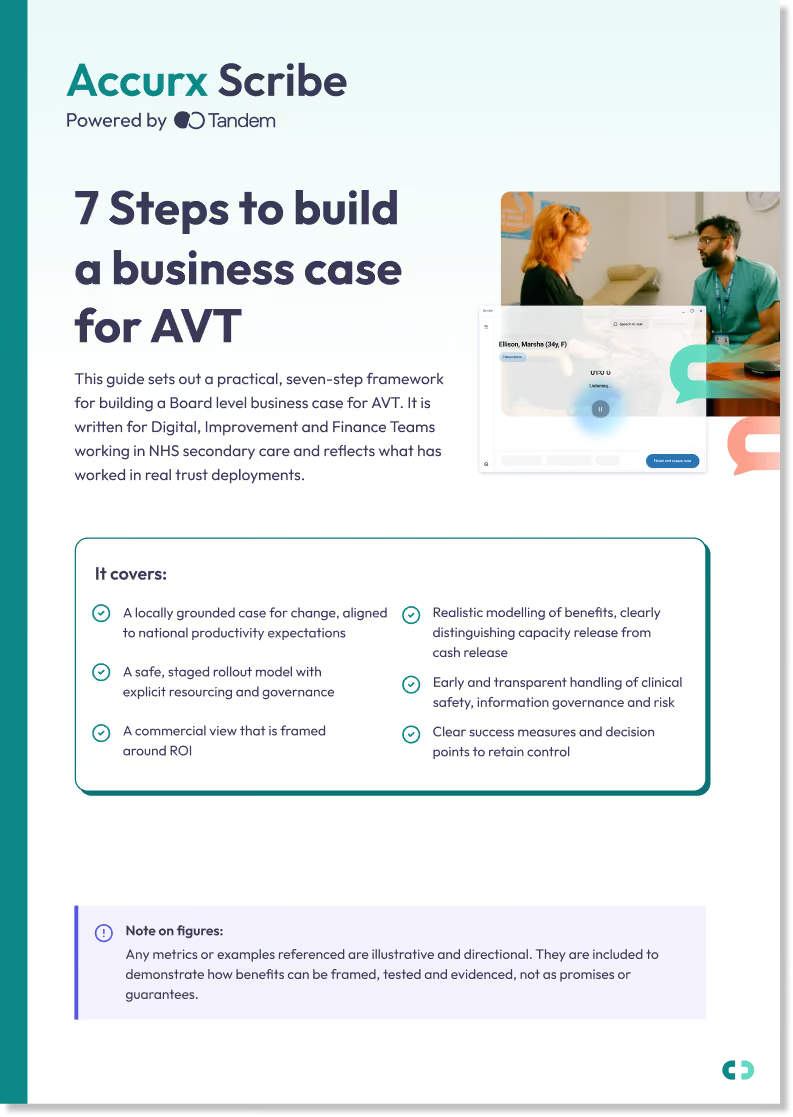
This guide sets out a practical, seven-step framework for building a Board-level business case for Ambient Voice Technology (AVT).

It is written for Digital, Improvement and Finance teams working in NHS secondary care. It reflects what has worked in real trust deployments, and where proposals most often fall down under scrutiny.
It starts with a clear, locally grounded articulation of the operational problem the trust is trying to solve, aligned to national productivity expectations and framed in terms the Board already recognises.
This framework helps you translate interest in AVT into a structured, defensible proposal. One that models benefits realistically, addresses clinical safety and governance early, and sets out a safe, staged route to ROI.
Download the full framework
Female patient with arm in cast uses phone to communicate with network of healthcare professionals

What this guide covers

A strong business case does not begin with the product. It begins with the problem the trust is trying to solve.

This framework walks you through how to:

  • Establish a locally grounded case for change aligned to national productivity expectations
  • Build a realistic benefits model that clearly distinguishes capacity release from cash release
  • Define a safe, staged rollout model with explicit resourcing and governance
  • Address clinical safety, information governance and risk early and transparently
  • Frame the commercial case around defensible ROI
  • Set clear success measures and decision points to retain control at every stage

Seven steps to building a credible AVT business case

1. Anchor the case for change in operational reality
Boards respond to local data, not generic claims. The framework shows how to articulate the documentation burden, workforce pressure and flow challenges in terms your Board already recognises, and how to link AVT to measurable operational impact.
2. Build a cautious, defensible benefits model
Finance scrutiny will focus on assumptions and attribution. We outline how to model time savings conservatively, pressure-test assumptions with clinicians, and translate productivity gains into organisational value without overstating what AVT can deliver.
3. Define a safe, staged rollout
Trusts that struggle often scale too quickly. The guide sets out a pathway from discovery to governed pilot to phased trust-wide rollout, with realistic timelines and internal resourcing requirements.
4. Address clinical safety and IG upfront
Approval friction most often sits with safety and governance. We show how to frame your case using NHS AI assurance language, DCB0129/DCB0160 standards, and clear mitigation plans that give confidence without creating delay.
5. Spell out options, costs and ROI clearly
Boards expect comparison and trade-offs. The framework explains how to structure your options appraisal, cost model and three-year ROI view in a way that is cautious, transparent and defensible.
6. Define governance and measurable success
AVT should be positioned as a transformation programme, not a background IT deployment. We outline how to define ownership, evaluation and success criteria.
7. Plan for stakeholder dynamics
Even strong cases fail if organisational realities are ignored. The guide explores how to build coalitions of support, anticipate concerns from Finance, IG and clinical leaders, and handle resistance constructively.

Download the seven-step framework and pressure-test your current AVT proposal

The AVT Academy

For more practical resources, templates and expert guidance on how to implement AVT safely and effectively in your trust visit The AVT Academy.

Find out more